
What is SSL/TLS certificate
-
An SSL/TLS certificate is a digital certificate installed on a web server that enables encrypted, secure communication between the server and any client connecting to it. Without one, all data exchanged between a user's browser and your server is transmitted in plain text — meaning anyone positioned between the user and the server, such as a network operator, a public Wi-Fi administrator, or a malicious third party, can intercept and read that data. This includes passwords, payment details, and personal information.
SSL/TLS is also what makes HTTPS possible. HTTP (HyperText Transfer Protocol) is the standard protocol for data transfer between a browser and a server, but it offers no encryption. Adding an SSL/TLS certificate upgrades it to HTTPS, which you can recognize by the https:// prefix and padlock icon in the browser address bar. Without a certificate, the URL will show http://, and the browser will mark the site as “Not Secure,” which negatively affects user trust and search engine rankings.
-
-
*
How SSL/TLS Works
SSL/TLS encryption is based on a key pair: a public key and a private key. The public key is embedded in the SSL certificate and is shared openly — it is used to encrypt data sent to your server. The private key stays on the server and is never shared; it is the only key that can decrypt what the public key encrypts.
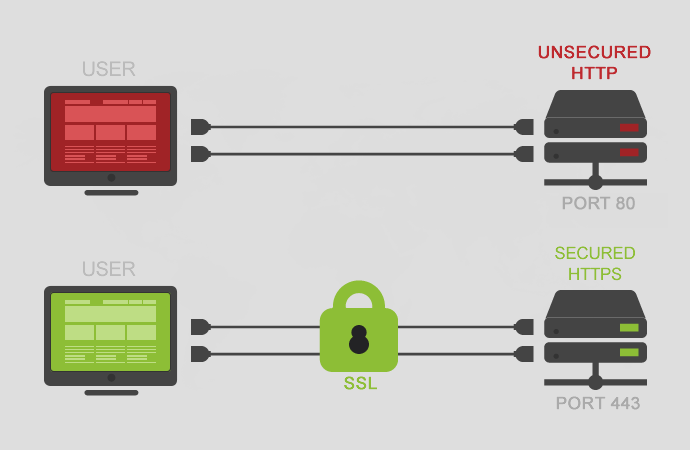
In practice, when a user visits your site, their browser uses your public key to establish a secure session. From that point on, all data exchanged between the browser and the server is encrypted and unreadable to anyone who might intercept it.
-
*
What Is the Difference Between SSL and TLS?
SSL (Secure Sockets Layer) was the original name of the protocol, first introduced in the 1990s. TLS (Transport Layer Security) is its successor and has been the actual standard used for secure connections since the early 2000s. SSL 2.0 and SSL 3.0 have both been officially deprecated due to known security vulnerabilities.
In practice, the term “SSL certificate” has remained in widespread use as the name for the certificate itself, even though the underlying protocol is TLS. When you purchase an “SSL certificate” from GoGetSSL, the connections it secures will use TLS.
-