


Why Employees Still Fall for Phishing and How Organizations Can Reduce the Risk
-
Organizations invest heavily in cybersecurity technologies, access controls, and security policies, yet incidents still occur. One major reason is the human element.
Even sophisticated security systems cannot prevent every employee from clicking a malicious link, trusting an impersonated executive, sharing credentials, or bypassing an established security procedure.
Understanding why people make these decisions is therefore an essential part of building effective phishing defenses. The goal should not be to simply label employees as the "weakest link," but to understand the psychological and practical factors attackers exploit and help employees become an active security layer.
-
-
*
Understanding Human Vulnerability in Cybersecurity
Phishing succeeds because attackers understand human psychology. They deliberately exploit cognitive shortcuts and emotional responses such as urgency, fear, curiosity, and trust. Fatigue, heavy workloads, and tight deadlines can make these techniques even more effective.
The modern workplace has also created new opportunities for social engineering. Collaboration platforms such as Microsoft Teams and other messaging tools allow employees to communicate quickly with colleagues and external users, creating additional channels for phishing.
Artificial Intelligence (AI) adds another layer to the problem. Generative AI can help attackers produce polished messages that imitate corporate language and communication styles. Many phishing messages no longer contain the obvious spelling mistakes and awkward wording traditionally associated with scams.
For organizations, this means addressing not only technical vulnerabilities but also the knowledge, habits, and psychological factors that influence employee behavior.
-
*
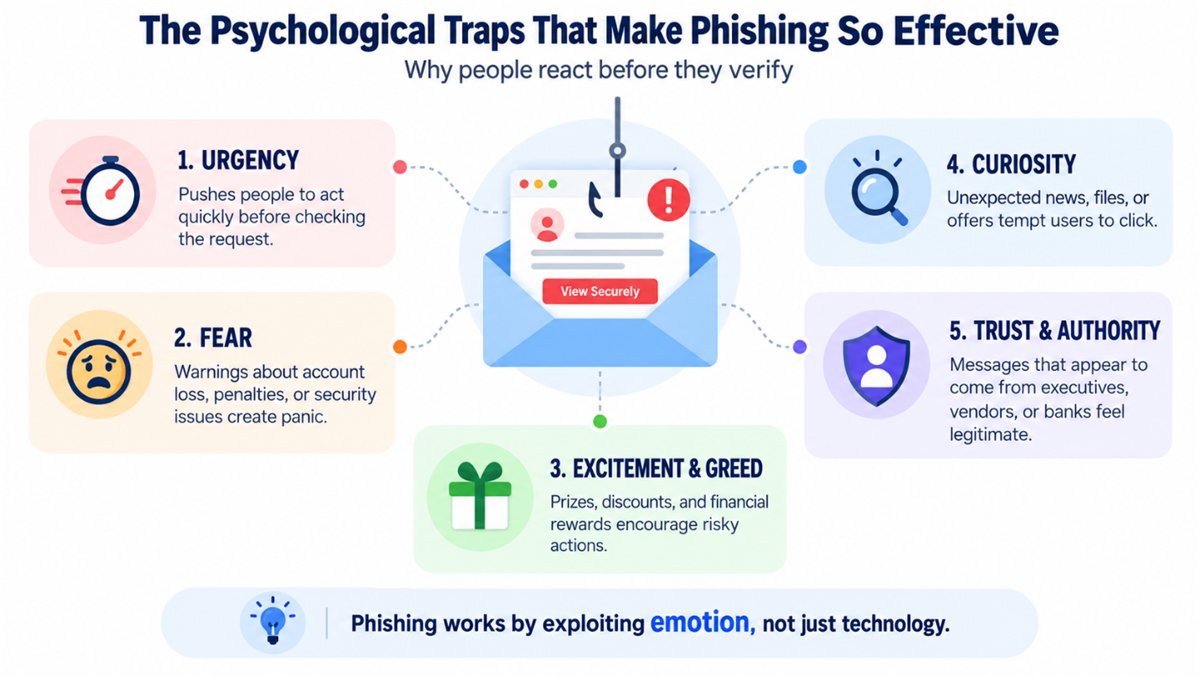
The Psychological Traps That Make Phishing So Effective
Cybercriminals rarely rely on technology alone. Successful phishing messages are often designed to trigger an emotional response before the recipient has time to evaluate the request carefully.
Urgency
Urgency encourages people to act quickly instead of stopping to verify a request. Attackers frequently use deadlines, account warnings, or time-sensitive business requests to create pressure.
Example: An employee receives a message claiming that a password must be updated immediately or that access to an important corporate application will be suspended.
Fear
Fear can have a similar effect. Threats involving account suspension, financial penalties, legal consequences, or security incidents may push recipients into acting before checking whether the message is legitimate.
Example: A message claims that an account has been suspended and asks the user to enter login credentials immediately to restore access.
Curiosity
Attackers also exploit the natural desire to discover something unexpected or interesting. Exclusive offers, surprising documents, unusual news, or unexpected opportunities can encourage users to click.
Example: A recipient receives a message promising an exclusive offer or unexpected financial reward and is asked to follow a link to learn more.
Trust and Authority
Messages appearing to come from banks, software providers, managers, executives, or existing business partners can benefit from established trust.
Authority adds additional pressure. Employees may be reluctant to question a request that appears to come from a senior executive or another person with decision-making power.
Example: An employee receives an apparently legitimate message from a familiar vendor asking them to review an urgent security notification.
Excitement and Greed
Promises of prizes, discounts, investments, or financial rewards remain effective phishing triggers.
Attackers combine excitement with urgency to encourage recipients to act before considering whether the offer is realistic.
Example: A message claims that the recipient has won a prize but must provide financial information or make a small payment before receiving it.
-
*
Common Mistakes That Keep Phishing Successful
Psychological triggers explain why phishing messages attract attention. Everyday security mistakes can then give attackers the opportunity they need.
Weak and Reused Passwords
Weak passwords and password reuse remain significant security risks. If attackers obtain credentials through phishing or another breach, reused passwords may allow them to access additional corporate services.
Organizations should therefore combine strong password policies with Multi-Factor Authentication (MFA) and other identity-security controls.
Emotional Clicking
Even users who understand phishing risks may react instinctively when a message creates enough urgency, fear, or excitement.
Security awareness should therefore teach employees to pause and verify unusual requests rather than simply memorize a list of suspicious email characteristics.
Social Engineering
Social engineering has become increasingly sophisticated. Attackers can combine phishing with Artificial Intelligence (AI), voice impersonation, fake identities, and other techniques to build trust gradually.
A request may initially appear harmless. The attacker can then move the conversation toward credentials, financial information, confidential data, or another valuable target.
Mismanagement and Negligence
Security procedures only work when employees follow them.
Consider a financial process that requires additional authorization before a large payment can be made. If an employee bypasses that procedure because a message appears urgent, a phishing attempt may succeed even though the organization has appropriate controls in place.
Clear procedures, verification requirements, and separation of duties can therefore reduce the impact of social engineering.
Malicious Insiders
Not every human-related security incident is accidental. Employees, contractors, or other trusted users may intentionally misuse their access or expose sensitive information.
This is another reason organizations should apply the principle of least privilege, monitor sensitive activity, and avoid granting unnecessary access simply because a user is inside the corporate environment.
-
*
The Necessity of Cybersecurity Awareness Training
Security awareness training gives employees practical knowledge for recognizing threats, protecting sensitive information, and responding appropriately when something suspicious occurs.
Effective training should cover the current threat landscape, common phishing techniques, social-engineering tactics, reporting procedures, and everyday security practices.
Awareness programs can also support regulatory and compliance requirements, including those associated with frameworks such as the General Data Protection Regulation (GDPR) and the Health Insurance Portability and Accountability Act (HIPAA).
However, training should not exist simply to satisfy a compliance requirement. Its primary purpose should be changing security behavior.
-
*
What an Effective Awareness Program Looks Like: A 5-Step Framework
1. Leadership Buy-In
Security culture works best when leadership actively supports it.
Executives should treat cybersecurity awareness as a business-risk issue, provide appropriate resources, define responsibilities, and reinforce the importance of secure behavior throughout the organization.
2. Assign Ownership
Someone should have clear responsibility for the awareness program.
The person or team responsible should coordinate training, phishing simulations, metrics, communication, and improvements rather than treating awareness as an occasional administrative exercise.
3. Assess the Current Security Posture
Before designing training, determine what employees already understand and where weaknesses exist.
Short assessments, quizzes, phishing simulations, and incident data can help establish a baseline and identify groups that require additional attention.
4. Provide Regular Training
Security awareness should be continuous rather than a one-time annual event.
Use phishing simulations, short videos, quizzes, and bite-sized learning modules to keep employees engaged. Training should explain not only what employees should do, but why particular behaviors matter.
Realistic scenarios are especially valuable because they help users apply security principles to situations they may actually encounter.
5. Monitor, Measure, and Improve
Training effectiveness should be measured rather than assumed.
Useful Key Performance Indicators (KPIs) can include phishing simulation click rates, reporting rates, training completion, password hygiene, and the number of security incidents reported by employees.
These metrics help organizations identify weaknesses and continuously improve their awareness programs.
-
*
Pair Employee Training with Technical Safeguards
Employee awareness is important, but it should never be the only phishing defense.
Organizations should combine training with technical controls that detect malicious links, analyze suspicious attachments, protect identities, and authenticate legitimate email.
Email authentication should include Sender Policy Framework (SPF), DomainKeys Identified Mail (DKIM), and Domain-based Message Authentication, Reporting, and Conformance (DMARC). Together, these mechanisms help receiving systems authenticate email and reduce opportunities for direct domain spoofing.
Organizations can further strengthen authenticated brand communication using Brand Indicators for Message Identification (BIMI) together with Mark Certificates.
A Verified Mark Certificate (VMC) supports authenticated display of a qualifying trademarked brand logo in compatible email environments. A Common Mark Certificate (CMC) provides another BIMI certificate option for organizations whose logos may not qualify for a VMC.
These mechanisms do not replace SPF, DKIM, DMARC, anti-phishing technology, or employee training. Instead, they form part of a layered email-security strategy.
When technical controls filter out obvious threats, employees can focus their attention on the more sophisticated phishing attempts that make it through.
-
*
Conclusion
Employees are often described as the weakest link in cybersecurity, but that does not have to be the case.
With practical training, clear procedures, realistic phishing simulations, and appropriate technical safeguards, employees can become an important layer of defense against attacks that technology alone may not catch.
Building that security culture takes time. The strongest approach combines technology, education, awareness, and shared responsibility helping employees recognize suspicious behavior, question unusual requests, and respond before a phishing attempt becomes a security incident.
-
