


Email Security Best Practices for SMBs and Enterprises
-
Email attacks do not discriminate by company size. Small and medium-sized businesses (SMBs) and large enterprises face many of the same threats, including phishing, Business Email Compromise (BEC), credential theft, and ransomware.
For SMBs, the main challenge is often limited security resources. Smaller organizations may have fewer dedicated cybersecurity specialists, basic security tools, and less mature security processes.
Enterprises usually have larger security budgets, but size introduces a different problem: complexity. More employees, applications, vendors, devices, and inboxes create a much larger attack surface.
Verizon's 2025 Data Breach Investigations Report (DBIR) found that social attacks represented a comparable share of breaches in SMBs and large organizations, with phishing remaining a primary social-engineering technique.
-
-
*
Common SMB Vulnerabilities
- limited security budgets;
- no dedicated Chief Information Security Officer (CISO) or Security Operations Center (SOC);
- reliance on basic security tools;
- limited employee security awareness;
- fewer advanced controls and formal security processes.
-
*
Common Enterprise Weak Points
- complex IT environments;
- large numbers of users and inboxes;
- growing application and vendor sprawl;
- difficulty integrating multiple security tools;
- sophisticated phishing and Business Email Compromise attacks.
Company size does not determine security. The right email-security strategy depends on combining appropriate technical controls, employee awareness, and incident-response processes.
-
*
Technical Best Practices for Secure Business Email
The core security principles are similar for SMBs and enterprises, although the scale and implementation may differ.
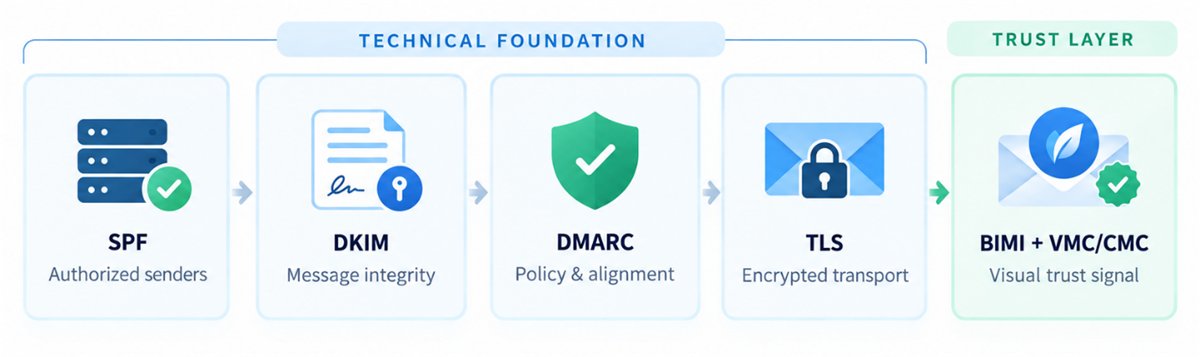
Sender Policy Framework
Sender Policy Framework (SPF) allows domain owners to specify which mail servers are authorized to send email on behalf of their domain.
Receiving mail systems can compare the sending server against the domain's published SPF record, helping reduce direct domain spoofing.
DomainKeys Identified Mail
DomainKeys Identified Mail (DKIM) adds a cryptographic signature to outgoing email.
Receiving systems verify the signature using a public key published in the Domain Name System (DNS). This helps confirm that signed parts of the message were not modified during delivery and that the message was authorized by the signing domain.
Domain-based Message Authentication, Reporting, and Conformance
Domain-based Message Authentication, Reporting, and Conformance (DMARC) works with SPF and DKIM to strengthen domain authentication.
DMARC checks alignment between the authenticated domain and the address visible to the recipient. Domain owners can also publish policies that tell receiving systems how to handle messages that fail authentication.
DMARC reporting provides visibility into legitimate and unauthorized use of the domain.
Transport Layer Security
Transport Layer Security (TLS) encrypts email while it travels between compatible mail servers.
TLS protects messages in transit from passive interception and helps secure communication between mail systems. It complements sender-authentication protocols rather than replacing them.
-
*
Why a Layered Approach Matters
No single protocol provides complete email protection.
SPF helps identify authorized sending infrastructure, DKIM protects message integrity, DMARC adds alignment and policy enforcement, while TLS protects messages during transport.
Organizations can extend this layered approach with Brand Indicators for Message Identification (BIMI). When used with appropriate authentication and a Verified Mark Certificate (VMC) or Common Mark Certificate (CMC), BIMI can provide an additional visual identity signal in supported inboxes.
-
*
User-Focused Practices for Safer Email Communication
Technology can block many threats, but attackers continue to target employees directly.
The strongest email-security programs combine technical controls with practical security habits.
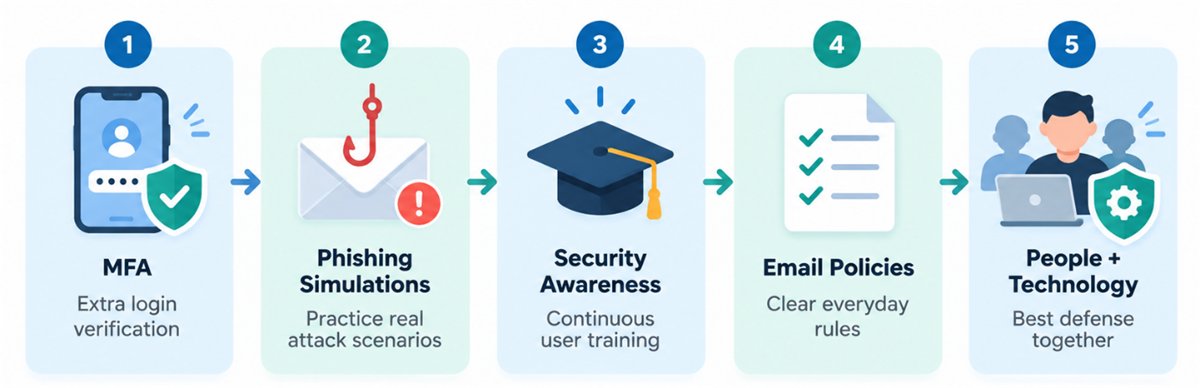
1. Multi-Factor Authentication
Multi-Factor Authentication (MFA) adds another verification step beyond the password.
If credentials are stolen through phishing, additional authentication can make unauthorized access more difficult.
Where possible, organizations should consider phishing-resistant authentication methods for high-risk accounts.
2. Regular Phishing Simulations
Controlled phishing simulations help employees practice recognizing suspicious messages in realistic scenarios.
They can also help security teams identify departments or user groups that require additional training.
3. Continuous Security Awareness
Security awareness should be an ongoing process rather than an annual compliance exercise.
Training should cover current phishing techniques, impersonation, suspicious links and attachments, payment fraud, credential requests, and reporting procedures.
4. Clear Email Usage Policies
Employees need simple rules they can follow in everyday situations.
Policies should explain how to handle:
- unexpected links and attachments;
- credential requests;
- unusual payment instructions;
- changes to supplier bank details;
- suspicious executive requests;
- potential phishing incidents.
5. Balance People and Technology
Technical controls cannot eliminate every phishing message, and training cannot compensate for missing security controls.
The most resilient approach combines both.
-
*
Response Planning and Incident Handling
Every organization should be prepared for the possibility that an email attack succeeds.
Incident response should be planned in advance rather than improvised after a compromise.
Define Incident Response Roles
The response team may include:
- security and IT personnel;
- executive leadership;
- finance;
- Human Resources (HR);
- legal and compliance teams;
- Public Relations (PR);
- external security specialists.
Enterprises may rely on a CISO and SOC, while smaller businesses may assign incident responsibilities to internal leadership and external security providers.
A designated incident manager can coordinate investigation, communication, documentation, and recovery.
Key Incident Response Priorities
A practical response process should include:
- clear incident classification and escalation procedures;
- predefined internal and external communication channels;
- preservation of logs, suspicious emails, and other evidence;
- rapid isolation of compromised accounts or endpoints;
- credential resets and session revocation where necessary;
- removal of malicious files or persistence mechanisms;
- secure restoration of affected systems;
- post-incident review and documentation.
Every incident should feed lessons back into security policies, employee training, and technical controls.
-
*
Email Security Tools for SMBs and Enterprises
The right security stack depends on business size, risk, technical expertise, and available resources.
For SMBs
SMBs generally benefit from solutions that provide broad protection without excessive operational complexity.
Useful options include:
- Cloud-based Secure Email Gateways (SEGs) for spam, phishing, malware, and policy enforcement;
- built-in security platforms available through Microsoft 365 or Google Workspace;
- phishing simulation tools for employee training;
- Managed Security Service Providers (MSSPs) or SOC-as-a-Service when maintaining an internal security team is impractical.
Key priority for SMBs: Keep the security stack manageable. Strong foundational controls and well-integrated services are usually more valuable than numerous disconnected tools.
For Enterprises
Large organizations need controls capable of operating across large user populations, complex infrastructure, and high email volumes.
Useful capabilities include:
- Threat Intelligence Platforms (TIPs) for emerging threats and malicious infrastructure;
- AI-assisted behavioral analytics for account takeover, unusual activity, and targeted phishing;
- advanced phishing simulation platforms with role-based scenarios and detailed analytics;
- dedicated Security Operations Center (SOC) teams or Managed Detection and Response (MDR) services.
Key priority for enterprises: Integrate security signals so that threats can be detected, investigated, and contained across the wider environment.
-
*
Cross-Business Email Security Checklist
Whether protecting a small business or a global enterprise:
- configure SPF, DKIM, DMARC, and TLS correctly;
- enforce Multi-Factor Authentication;
- maintain regular employee awareness training;
- run realistic phishing simulations;
- make suspicious-email reporting easy;
- monitor domain and email-security activity;
- maintain a tested incident-response plan;
- review third-party and vendor access;
- measure reporting rates, phishing interactions, and response times;
- avoid unnecessary security-tool sprawl;
- review configurations regularly to prevent security gaps.
SMBs should prioritize strong foundational coverage and operational simplicity. Enterprises should prioritize integration, automation, visibility, and scalable response.
-
*
Conclusion
Email will remain an important attack vector for organizations of every size.
SMBs may struggle with limited resources, while enterprises must manage larger and more complex environments. Despite these differences, the fundamentals of effective email security remain similar.
A strong strategy combines email authentication, encryption, access protection, employee awareness, phishing simulations, monitoring, and incident response.
Email security should therefore be treated as a continuous process rather than a one-time deployment. As threats evolve, the controls, training, and procedures used to protect business communication should evolve with them.
-
