


Email Phishing Tactics Every CISO Should Know
-
Chief Information Security Officers (CISOs) face growing pressure to protect organizations against increasingly sophisticated phishing attacks. Artificial Intelligence (AI), deepfakes, multi-channel social engineering, and ready-made attack platforms are making phishing easier to launch and harder to detect.
Understanding these techniques is essential for building defenses that can evolve alongside the threat landscape.
-
-
*
The Evolving Threat Landscape of AI Phishing
Artificial Intelligence is changing how phishing campaigns are created and scaled.
Attackers can use generative AI to produce convincing messages, imitate corporate language, personalize content, and create multiple campaign variations quickly.
At the same time, Phishing-as-a-Service (PhaaS) platforms provide ready-made phishing templates, credential-harvesting infrastructure, campaign dashboards, and other tools that lower the technical barrier for attackers.
For CISOs, this means phishing is increasingly becoming an organized criminal ecosystem rather than a collection of isolated attacks.
-
*
Emerging Techniques Driving the Next Wave of Phishing Attacks
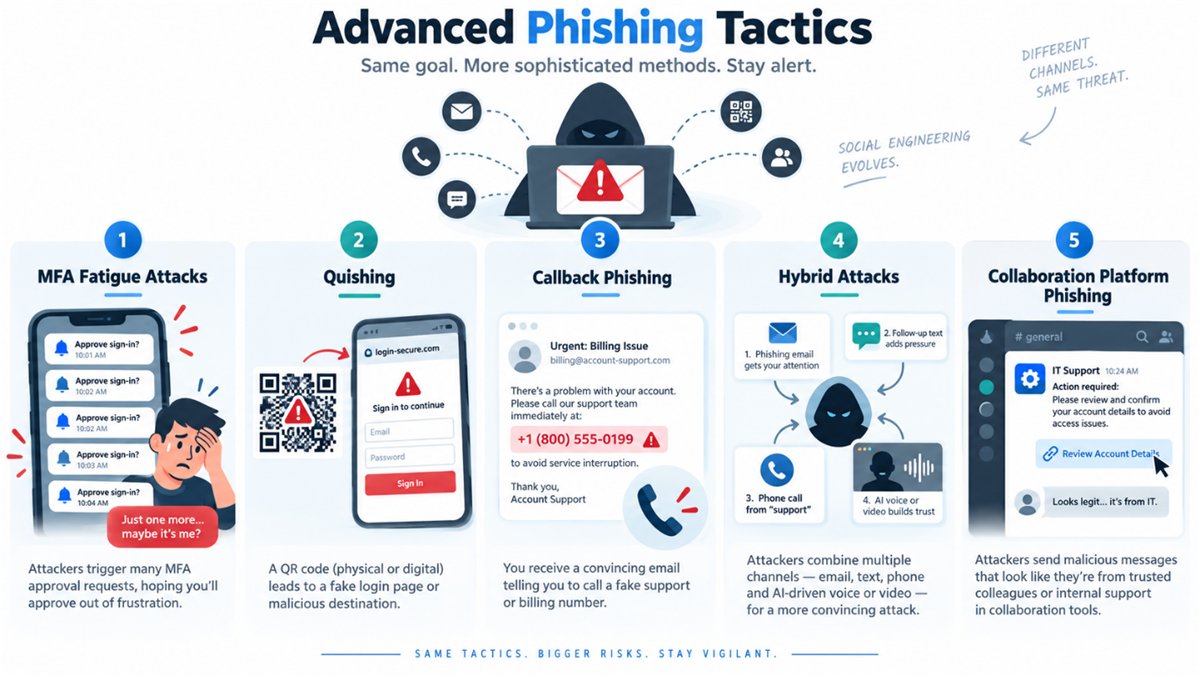
Modern phishing campaigns are moving beyond traditional malicious links and attachments. Attackers increasingly exploit authentication fatigue, mobile devices, voice communication, and workplace collaboration tools.
MFA Fatigue Attacks
Multi-Factor Authentication (MFA) remains an important security control, but attackers can exploit push-based authentication.
In an MFA fatigue attack, users receive repeated login approval notifications until frustration or confusion causes them to approve one.
Organizations should consider phishing-resistant authentication methods and train employees never to approve unexpected authentication requests.
Quishing
QR-code phishing, or quishing, hides malicious links inside QR codes.
Scanning the code may redirect users to fake login pages, payment forms, or credential-harvesting websites. QR codes can also make it more difficult for users to inspect the destination before opening it.
Callback Phishing
Callback phishing begins with an email that asks the recipient to call a supposedly legitimate support, billing, or security number.
Once the victim calls, the attacker uses social engineering to obtain credentials, persuade the user to install software, or initiate a fraudulent payment.
Hybrid Attacks
Attackers increasingly combine several communication channels.
An employee might first receive an email, followed by a phone call or message reinforcing the same story. AI-generated voice or video can make the impersonation even more convincing.
Collaboration Platform Phishing
Slack, Microsoft Teams, and other workplace platforms are also becoming phishing channels.
Attackers can imitate internal notifications, colleagues, or support requests. Because employees may naturally trust workplace communication tools, malicious messages can be especially effective.
-
*
Tactics Behind Business Email Compromise
Business Email Compromise (BEC) is a targeted form of social engineering in which attackers impersonate executives, vendors, partners, or other trusted contacts.
The objective is usually to persuade employees to transfer money, disclose sensitive information, or provide access to corporate systems.
Unlike mass phishing, BEC campaigns are often carefully tailored to normal business activity.
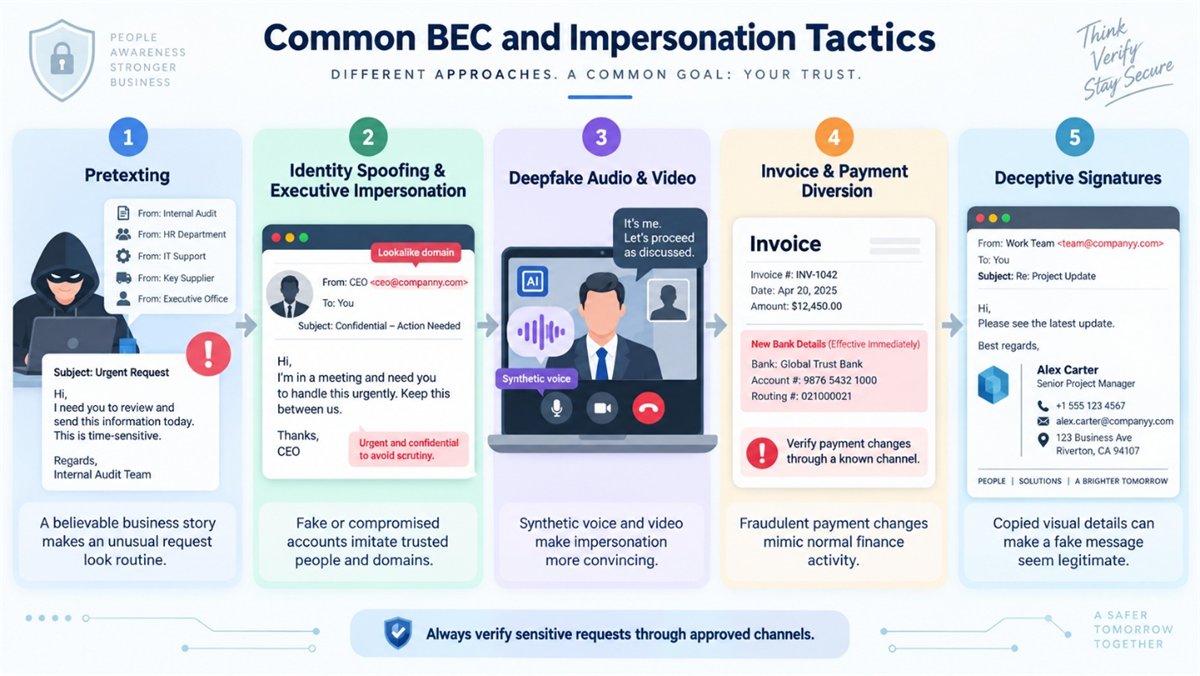
Pretexting
Pretexting relies on a believable business story.
The attacker may impersonate an auditor, Human Resources representative, IT administrator, supplier, or executive to make an unusual request appear routine.
Urgency and authority are commonly used to reduce the likelihood that an employee will verify the request.
Identity Spoofing and Executive Impersonation
Attackers may use lookalike domains, manipulated sender information, or compromised legitimate accounts to impersonate colleagues and business partners.
Executive impersonation is particularly effective because employees may hesitate to question requests that appear to come from senior leadership.
Deepfake Audio and Video
AI-generated voice and video add another layer to impersonation attacks.
Attackers can imitate executives or trusted contacts and use synthetic media to support fraudulent financial or data requests.
Sensitive actions should therefore require independent verification through approved communication channels.
Invoice and Payment Diversion
Attackers frequently imitate legitimate financial processes.
A message may claim that a supplier has changed bank details, an invoice requires urgent payment, or a transaction needs to be redirected.
Payment changes should always be independently verified using previously established contact information.
Deceptive Signatures
Corporate logos, email signatures, contact details, and visual branding can be copied easily.
These elements may make a fraudulent message appear familiar, but visual similarity alone does not prove that the sender is legitimate.
-
*
Supply-Chain Phishing Risk
Phishing risk extends beyond employees and internal systems.
Suppliers, contractors, service providers, and other partners often have established communication channels with organizations.
If attackers compromise a trusted vendor, they can use legitimate accounts and existing business relationships to send convincing phishing messages.
Such attacks may involve:
- fraudulent invoices;
- malicious attachments;
- credential theft;
- payment diversion;
- requests for sensitive information.
For CISOs, third-party security should therefore be considered part of the organization's own phishing risk.
-
*
How Can CISOs Stay One Step Ahead?
Phishing defense should move from a reactive model toward a layered and proactive security strategy.
- Combat AI Phishing with AI-Assisted Defense
Use behavioral analytics, anomaly detection, and contextual analysis to identify suspicious activity that traditional filtering may miss.
Security tools should evaluate not only message content but also whether communication and login activity match normal user behavior.
- Apply Zero Trust to Communication
Do not rely solely on familiar names, email signatures, phone calls, or video as proof of identity.
Require independent verification for high-risk requests such as:
- payments;
- bank-detail changes;
- credential resets;
- privileged access;
- sensitive data transfers.
For external branded email, Brand Indicators for Message Identification (BIMI) together with a Verified Mark Certificate (VMC) or Common Mark Certificate (CMC) can provide an additional visual trust signal in compatible inboxes.
- Deploy Advanced Email Security
Modern email security should combine several controls, including:
- behavioral analysis;
- impersonation detection;
- malicious-link inspection;
- attachment sandboxing;
- threat intelligence;
- account-takeover detection.
Organizations should also implement Sender Policy Framework (SPF), DomainKeys Identified Mail (DKIM), and Domain-based Message Authentication, Reporting, and Conformance (DMARC) to strengthen domain authentication and reduce spoofing.
- Run Role-Based Phishing Simulations
Different employees face different phishing risks.
Finance teams may encounter payment fraud, Human Resources teams may receive fake employee requests, and executives may be targeted with impersonation attacks.
Training and phishing simulations should reflect these role-specific scenarios.
- Assess Vendor Risk
Third-party compromise can become a direct security problem for your organization.
Vendor assessments should consider authentication controls, access privileges, security policies, incident-notification procedures, and relevant compliance requirements.
- Maintain an Incident Response Plan
Organizations should assume that some phishing attacks will succeed.
A tested phishing response playbook should cover:
- detection;
- containment;
- credential resets;
- session revocation;
- investigation;
- communication;
- recovery.
Regular exercises help identify weaknesses before a real incident occurs.
- Report Phishing Risk at Board Level
Phishing is not simply an email-security issue. Successful attacks can affect financial operations, business continuity, regulatory exposure, and customer trust.
CISOs should communicate phishing risk using clear business metrics such as:
- phishing reporting rates;
- BEC attempts;
- credential compromise;
- incident response times;
- financial exposure;
- high-risk third-party dependencies.
-
*
Conclusion
Phishing continues to evolve through Artificial Intelligence, Business Email Compromise, deepfakes, multi-channel attacks, and supply-chain compromise.
For CISOs, effective defense requires more than one technology or security product.
The strongest approach combines email security, identity verification, authentication, behavioral detection, employee awareness, vendor risk management, and incident response.
The goal is not only to prevent phishing messages from reaching employees, but also to ensure that a single successful interaction does not become a major security incident.
-
