


How Different Industries Are Fighting Email Phishing: Trends and Strategies
-
No industry is immune to phishing.
According to the Verizon 2025 Data Breach Investigations Report (DBIR), phishing accounted for approximately 15% of initial access in analyzed breaches. But the more important trend is how phishing campaigns are becoming increasingly tailored to specific industries and business processes.
-
-
*
Why Is Phishing So Attractive to Attackers?
Phishing offers criminals a relatively low barrier to entry while providing access to potentially valuable outcomes, including:
- stolen credentials;
- unauthorized system access;
- financial fraud;
- sensitive business data;
- lateral movement through corporate networks.
Unlike many purely technical attacks, phishing primarily targets people. Attackers attempt to persuade employees to take an action that bypasses existing security controls.
Phishing can also be scaled and automated. However, modern campaigns increasingly prioritize relevance over volume.
Instead of sending the same message to thousands of unrelated recipients, attackers can imitate the workflows, terminology, and pressures of a specific industry.
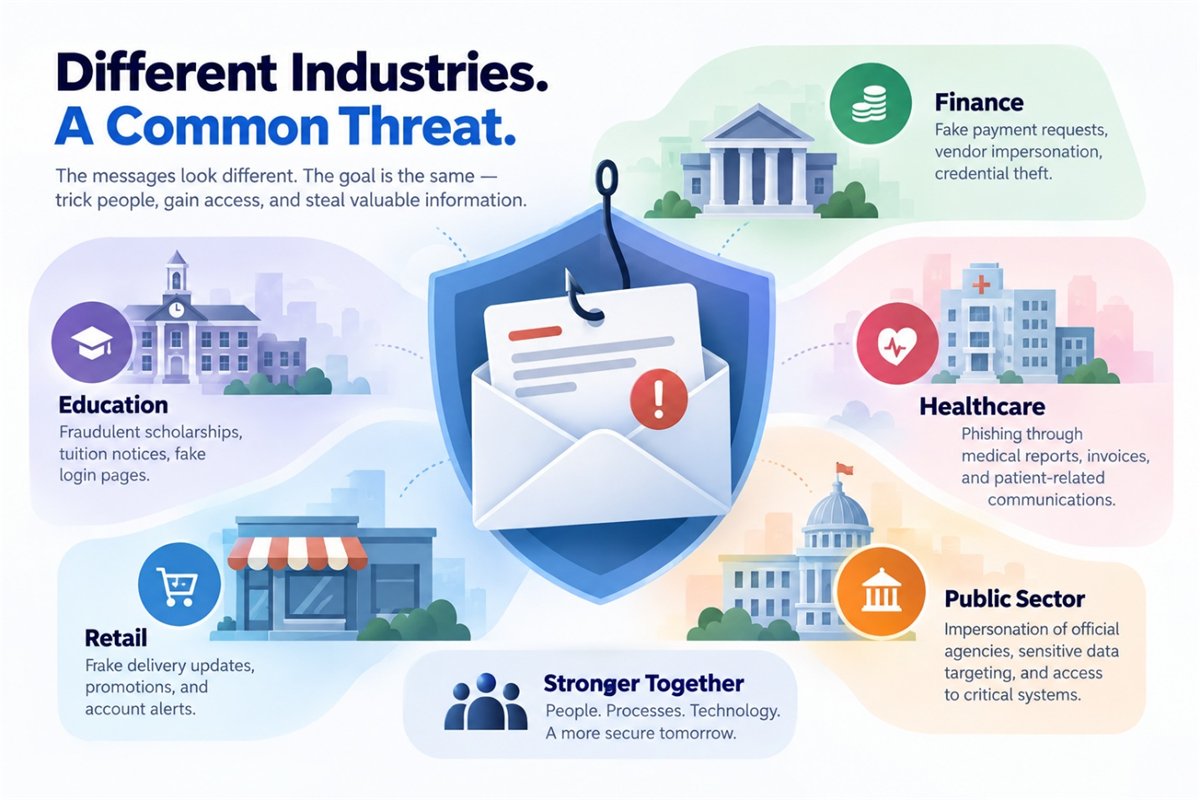
A healthcare worker may receive a fake test result or medical invoice. A finance employee may receive an urgent wire-transfer request. A retailer may see a fraudulent shipping notification. A university employee may receive a fake grant or account message.
The more closely a phishing message resembles normal business activity, the harder it can be to recognize.
-
*
Phishing in Finance: A High-Value Target
Financial institutions remain attractive phishing targets because their daily operations involve money, sensitive identities, and high-value transactions.
Common attacks include Business Email Compromise (BEC), credential theft, fraudulent payment instructions, and executive or vendor impersonation.
Attackers often pose as trusted individuals or organizations to convince employees to disclose sensitive information or authorize financial transactions.
Why Financial Institutions Are Prime Phishing Targets
Money moves constantly through treasury operations, payroll, customer transactions, vendor payments, and internal finance processes.
Financial organizations also hold valuable Personally Identifiable Information (PII), account records, credit information, and transaction histories.
A successful attack can therefore result in direct financial theft, identity fraud, data exposure, regulatory consequences, and reputational damage.
Recommended Measures
- Use layered authentication across critical financial systems and workflows.
- Apply Multi-Factor Authentication (MFA) to reduce the impact of stolen credentials.
- Monitor unusual login, account-access, and transaction behavior.
- Require additional verification for wire transfers, payment changes, and other high-risk transactions.
- Train finance employees to recognize Business Email Compromise, fake invoices, vendor impersonation, and payment-diversion attempts.
- Run regular phishing simulations based on realistic financial scenarios.
-
*
Phishing in Healthcare: Sensitive Data in the Crosshairs
Healthcare phishing campaigns often imitate routine communications such as test results, invoices, insurance documents, account notifications, and internal medical requests.
Attackers may also use pretexting, voice impersonation, or Artificial Intelligence (AI)-generated content to gain access to highly sensitive information.
Why Healthcare Is a Major Phishing Target
Healthcare organizations store valuable information, including:
- patient medical histories;
- insurance information;
- test results;
- billing information;
- Personally Identifiable Information.
This information is also subject to regulatory frameworks such as the Health Insurance Portability and Accountability Act (HIPAA) in the United States and the General Data Protection Regulation (GDPR) in the European Union.
Healthcare environments can be particularly complex because hospitals and medical organizations interact with laboratories, insurers, device manufacturers, suppliers, contractors, and other third parties.
Each relationship introduces communication and access pathways that attackers may attempt to exploit.
Recommended Measures
- Apply the principle of least privilege to sensitive data and systems.
- Segment clinical, administrative, and other critical environments where appropriate.
- Enforce Multi-Factor Authentication for email, Electronic Health Record (EHR) systems, and other sensitive applications.
- Tailor security awareness training to different roles, including clinicians, administrators, billing teams, and insurance staff.
- Maintain a tested incident-response playbook covering credential resets, system isolation, investigation, and recovery.
-
*
Phishing in Retail: Exploiting Customer Trust
Retail is built around continuous interaction between businesses, customers, suppliers, logistics providers, and payment services.
Attackers can exploit those trusted interactions through fake delivery notifications, fraudulent promotions, gift-card scams, account alerts, and lookalike websites.
Messages offering unusually attractive discounts or urgent shipping updates may redirect victims to phishing pages designed to collect login credentials or payment information.
Why Retail Is Under Attack
Retail organizations operate through numerous communication and sales channels, including:
- email;
- online stores;
- mobile applications;
- text messages;
- customer-support systems;
- Point-of-Sale (POS) systems.
Large retailers also depend on extensive networks of vendors, logistics companies, payment processors, and external service providers.
That combination creates many opportunities for attackers to impersonate legitimate brands or business partners.
Recommended Measures
- Implement Sender Policy Framework (SPF), DomainKeys Identified Mail (DKIM), and Domain-based Message Authentication, Reporting, and Conformance (DMARC) to strengthen email authentication and reduce direct domain spoofing.
- Use Brand Indicators for Message Identification (BIMI) with a Verified Mark Certificate (VMC) or Common Mark Certificate (CMC) where appropriate to support authenticated logo display in compatible inboxes.
- Monitor lookalike domains, fraudulent websites, fake applications, and impersonating promotional pages.
- Publish official websites, support addresses, phone numbers, and communication channels so customers can verify legitimate contact information.
- Train employees handling payments, suppliers, and customer communication to verify unusual requests.
-
*
Phishing in Education: A Large and Diverse Attack Surface
Educational institutions face a particularly broad phishing attack surface.
Typical scams may include:
- fake campus login pages;
- fraudulent scholarship or financial-aid messages;
- tuition-payment requests;
- faculty or administrator impersonation;
- fake exam or results notifications;
- malicious coursework attachments.
Students, faculty members, researchers, administrators, and external partners may all use the same digital ecosystem, often across numerous applications and services.
Why Education Is Vulnerable to Phishing
Universities, colleges, and schools typically manage large and constantly changing user populations.
They may also depend on a combination of legacy systems, cloud platforms, learning-management systems, collaboration tools, and third-party educational services.
Cybersecurity maturity can vary significantly between departments, creating inconsistent protections across the institution.
Recommended Measures
- Enforce Multi-Factor Authentication for students, faculty, administrators, and critical academic platforms.
- Use Identity and Access Management (IAM) controls to restrict sensitive information to authorized accounts.
- Build phishing simulations around realistic education scenarios such as scholarship offers, tuition reminders, account notifications, and exam-related messages.
- Protect institutional domains with SPF, DKIM, and DMARC.
- Make phishing reporting simple and accessible through campus Information Technology (IT) helpdesks or Learning Management Systems (LMSs).
- Provide targeted training for students and staff rather than relying on a single awareness program for every audience.
-
*
Phishing in the Public Sector: Government and Critical Infrastructure
Government organizations are attractive targets because they manage sensitive citizen information, operational systems, financial processes, and critical infrastructure.
Phishing campaigns targeting government employees may impersonate public agencies, senior officials, international organizations, contractors, or trusted service providers.
In higher-risk scenarios, attackers may attempt to use compromised credentials to gain access to government networks or critical infrastructure environments.
Why the Public Sector Is Under Attack
Public-sector organizations can hold:
- citizen and tax records;
- financial information;
- defense or intelligence data;
- regulatory information;
- infrastructure and operational data.
Government environments can also be highly decentralized.
A national agency may have mature cybersecurity controls, while smaller regional or municipal organizations may operate with fewer resources and less consistent security practices.
This uneven security maturity can create opportunities for attackers.
Recommended Measures
- Apply a Zero Trust approach in which identities and access requests are continuously verified.
- Use network and system segmentation to limit the impact of compromised accounts.
- Share relevant threat intelligence between government agencies and critical-infrastructure operators.
- Enforce Multi-Factor Authentication, SPF, DKIM, DMARC, and other baseline security controls consistently.
- Maintain a coordinated incident-response plan with clearly assigned responsibilities.
- Regularly train employees using government-specific phishing scenarios and impersonation techniques.
-
*
Different Industries, Different Phishing Tactics
Although phishing affects every sector, attackers do not always use the same approach.
Industry Common Phishing Theme Primary Risk Finance Payment requests, executive or vendor impersonation Financial fraud and credential theft Healthcare Medical reports, billing, insurance, account access Patient data and system compromise Retail Deliveries, promotions, customer accounts Payment data and customer credentials Education Scholarships, tuition, campus portals Account compromise and institutional access Public Sector Official notices, agency impersonation Sensitive data and critical systems The underlying method remains the same: attackers imitate communications that recipients already expect to receive.
That is why sector-specific security awareness is so important.
-
*
Conclusion
Phishing remains effective because it targets both technology and human behavior.
The specific message may differ from one industry to another, but the core strategy is consistent: attackers attempt to make a fraudulent request look like a normal part of the recipient's work.
Effective protection therefore requires people, processes, and technology to work together.
Organizations should combine strong email authentication, Multi-Factor Authentication, access controls, monitoring, employee training, phishing simulations, and incident-response planning.
They should also adapt those controls to the realities of their industry.
A finance team needs to recognize payment diversion. Healthcare employees need to protect patient information. Retailers need to defend brand communications. Educational institutions need to secure large and changing user populations. Government organizations need consistent protection across decentralized environments.
The strongest anti-phishing strategy is therefore not one-size-fits-all. It should evolve with the industry's workflows, threat landscape, and the communication patterns attackers are trying to imitate.
-
