


Phishing Beyond Email: How Attacks Are Moving from Inboxes to Messaging Platforms
-
Phishing is no longer confined to email. As businesses adopt more communication and collaboration tools, attackers are following users into the platforms where everyday work now happens.
-
-
*
Slack, Microsoft Teams, WhatsApp Business, LinkedIn, and similar services have become additional channels for social engineering and phishing. Several workplace trends have contributed to this shift:
- Remote and hybrid work has changed how distributed teams communicate, collaborate, and exchange information.
- Growing IT environments have introduced more applications, identities, and communication channels that organizations must manage and secure.
- Bring Your Own Device (BYOD) policies increasingly blur the boundary between personal and corporate communication, creating additional opportunities for attackers.
The result is a broader and more fragmented attack surface. Email remains important, but modern phishing increasingly follows employees wherever business conversations take place.
Artificial Intelligence (AI) adds another dimension to the problem. Generative AI can help attackers create polished, context-aware messages adapted to a particular person, organization, or communication platform. What began primarily as inbox-based social engineering is evolving into a faster and more convincing multi-channel threat.
-
*
Slack, Teams, WhatsApp, and LinkedIn: New Phishing Frontiers
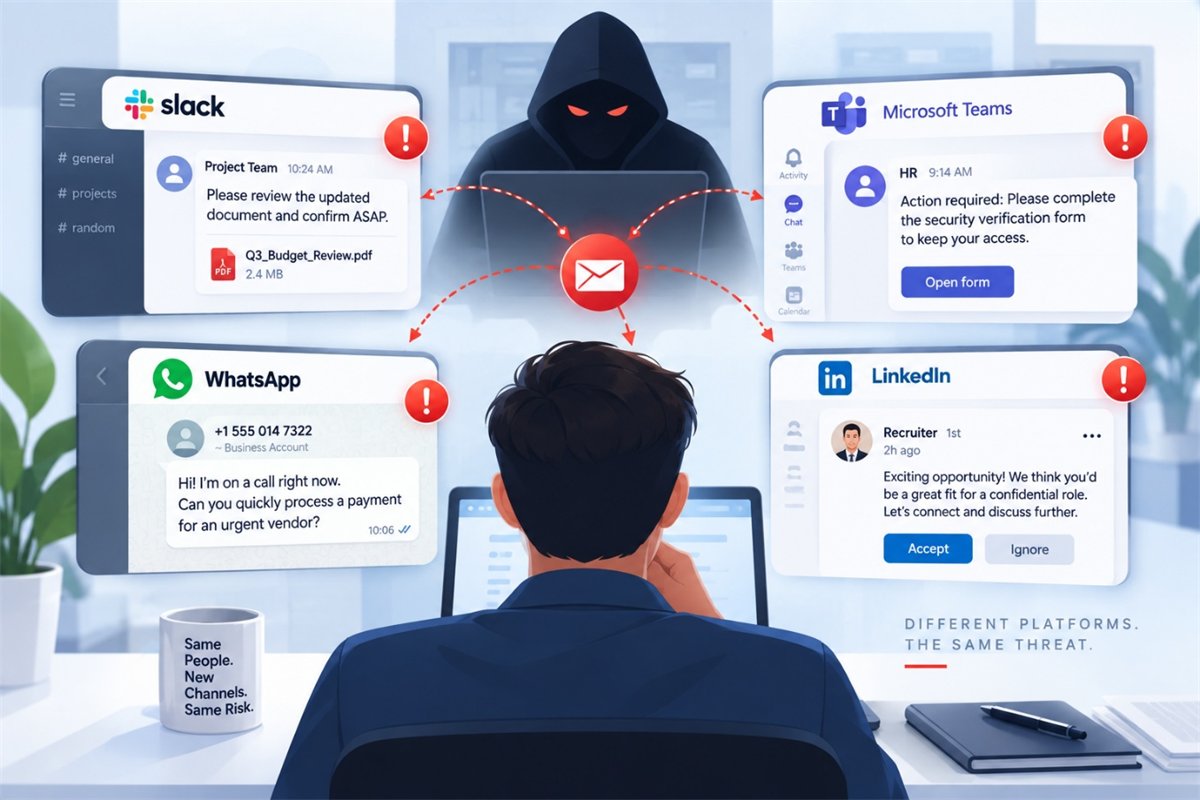
Security teams can no longer treat the inbox as the only significant phishing entry point. Slack, Microsoft Teams, WhatsApp, LinkedIn, and other communication platforms should also be considered potential initial attack vectors.
The reason is straightforward: these are the places where employees communicate every day. Users have also become more cautious about suspicious emails, while messages received through familiar collaboration tools may still carry an implicit sense of trust.
A Teams message appearing to come from a manager, a Slack request demanding immediate action, or a personalized LinkedIn message can therefore be highly effective. Attackers take advantage of both familiarity and the rapid pace of workplace communication.
Another challenge is the difference in security controls. Corporate email is commonly protected by multiple security layers, while equivalent protections may not always extend consistently across every collaboration and social platform.
Email also supports authentication and visual trust mechanisms such as Sender Policy Framework (SPF), DomainKeys Identified Mail (DKIM), Domain-based Message Authentication, Reporting, and Conformance (DMARC), Brand Indicators for Message Identification (BIMI), and Verified Mark Certificates (VMCs). Messaging and social platforms do not necessarily provide comparable standardized mechanisms for authenticating organizational messages.
-
*
Real-World Examples of Phishing Beyond the Inbox
Recent incidents demonstrate how attackers can exploit communication platforms outside traditional email:
- In early 2025, researchers identified a LinkedIn campaign associated with the North Korea-linked Lazarus Group. Attackers used convincing recruitment conversations and fake cryptocurrency-related job opportunities as part of attempts to steal information and deliver malware.
- Another LinkedIn campaign targeted high-value individuals with fraudulent job opportunities designed to capture session cookies and Microsoft account credentials.
- Electronic Arts experienced a Slack-related social engineering incident in 2021. Attackers manipulated an employee into providing access information, entered the company's internal environment, and ultimately stole a significant amount of corporate data.
- Security agencies have also warned about groups such as Scattered Spider using platforms including Slack and Microsoft Teams as part of highly targeted social-engineering operations.
- WhatsApp has become another channel for executive impersonation. In one reported case, criminals impersonated a senior executive of Greenko Group and persuaded employees to authorize fraudulent transfers.
These incidents demonstrate why phishing awareness can no longer focus solely on identifying suspicious emails. Collaboration platforms, messaging services, and professional social networks now require similar attention.
-
*
Cross-Platform Unified Threat Management
As communication becomes fragmented across multiple platforms, security visibility can become fragmented as well. Email systems, endpoints, identity platforms, messaging applications, and cloud services may each generate separate alerts and telemetry.
A unified approach helps security teams bring these signals together and identify suspicious activity across the broader communication environment.
Why Unified Threat Management Matters
Unified Threat Management (UTM) can consolidate information from multiple security controls into a coordinated security architecture.
Alerts originating from email gateways, endpoints, Identity and Access Management (IAM) systems, collaboration tools, and other sources can be correlated rather than investigated independently.
This broader visibility helps security teams understand how an attacker may be moving between identities, applications, and communication channels.
Centralized Control for Phishing Protection
Centralized security management can give teams a clearer view of cross-platform alerts, active incidents, and response actions from a common interface.
Instead of moving between disconnected security tools, analysts can investigate suspicious activity and coordinate actions from detection through containment more efficiently.
Centralized visibility can also support consistent security policies across departments and locations. Organizations may define access privileges, data-sharing restrictions, and Multi-Factor Authentication (MFA) requirements while identifying policy violations or configuration drift.
Threat Intelligence and Automated Response Playbooks
Threat Intelligence Platforms (TIPs) can enrich security systems with external threat intelligence, behavioral indicators, and information about emerging attack techniques.
Detection, however, should be followed by rapid response.
Automated phishing-response playbooks can help organizations take predefined actions when suspicious activity is detected. Depending on the incident, these actions may include quarantining an account, blocking a malicious domain, revoking authentication tokens, or notifying relevant security teams.
Automation makes response faster and more consistent, particularly when an attack crosses several platforms.
-
*
Security Awareness Training for Modern Communication Tools
As phishing expands beyond email, security awareness programs need to evolve as well.
Employees should understand that the same social-engineering principles used in phishing emails can appear in Teams messages, Slack conversations, WhatsApp texts, LinkedIn requests, and other communication channels.
The objective is not simply to teach users how to recognize suspicious emails. It is to help them question unexpected requests regardless of where those requests appear.
- Address the Gaps in Traditional Phishing Training
Email-focused training often teaches employees to examine sender addresses, suspicious links, attachments, and unusual subject lines. These lessons remain useful, but they are not sufficient for collaboration platforms.
Employees should also know how to verify an unusual request inside a Slack or Teams conversation, confirm an unexpected file-sharing request, and question a direct message from a manager asking for an urgent favor.
The interface may change, but the underlying social-engineering techniques remain similar.
- Move Toward Multi-Channel Phishing Awareness
Phishing simulations should increasingly reflect the communication tools employees actually use.
Scenarios can include Slack messages, Microsoft Teams invitations, WhatsApp conversations, and LinkedIn recruitment offers. For example, an employee might receive an apparently urgent Teams message from the Chief Financial Officer (CFO) requesting a payment.
Scenario-based exercises help employees recognize manipulation in context rather than memorizing a fixed list of phishing indicators.
- Define Clear Learning Objectives
A modern phishing-awareness program should teach employees to:
- verify unusual requests across different communication channels and recognize common social-engineering techniques;
- understand how to report suspicious activity on the platforms they use;
- know which types of corporate or sensitive information can and cannot be shared through collaboration and messaging tools.
These principles should remain consistent even when individual platforms or communication habits change.
- Measure Training Effectiveness Across Channels
The core metrics for evaluating phishing training remain useful across different platforms. Organizations can continue monitoring click rates, reporting rates, and time to report.
Additional measurements can include cross-platform detection rates and the number of real phishing incidents occurring through different communication channels.
Together, these metrics can help security teams identify where employees are most vulnerable and whether training is improving organizational resilience.
-
*
Conclusion
Defending against omnichannel phishing does not necessarily require adding more security tools. The priority should be creating a more coordinated security environment.
Organizations need visibility across the communication ecosystem rather than focusing exclusively on email. Unified threat management, modern security awareness, identity protection, and automated response can help security teams identify suspicious activity wherever it occurs.
A zero-trust approach also becomes increasingly important. Users and identities should be verified, access should be limited according to legitimate business requirements, and sensitive information should remain protected regardless of the application or communication channel through which it moves.
Artificial Intelligence will influence both sides of this security challenge. Attackers can use AI to make phishing more convincing, while security teams can use AI-assisted technologies to identify suspicious patterns across identities, platforms, and communications.
Ultimately, effective phishing defense depends on combining technology with continuous employee awareness. Organizations that can correlate threats across platforms, respond quickly, and train employees using realistic scenarios will be better prepared for phishing attacks that no longer begin or end in the inbox.
-
