


What Is SSL Offloading? How It Works, Benefits, and Types
-
SSL offloading is a network configuration in which TLS processing is handled by a device or service other than the backend web server.
Without offloading, a web server typically handles incoming HTTPS connections, performs TLS handshake operations, encrypts outgoing data, and decrypts incoming requests.
With TLS offloading, a separate component handles the client-facing TLS connection. It decrypts incoming traffic before forwarding requests to backend servers and encrypts responses before sending them back to visitors.
This approach can reduce the computational workload on backend servers and make it easier to manage encrypted traffic across a larger infrastructure.
Although the term SSL offloading is still widely used, modern HTTPS connections use TLS rather than the deprecated SSL protocols.
- Automatic renewals
- Less manual work
-
-
*
How Does SSL Offloading Work?
TLS offloading typically involves a load balancer, reverse proxy, application delivery controller (ADC), or another network device positioned between visitors and backend servers.
The process generally works as follows:
- A visitor connects to the website. The browser establishes an HTTPS connection with the load balancer or reverse proxy.
- The TLS handshake takes place. The intermediary presents the website's TLS certificate and establishes a secure connection with the client.
- Incoming traffic is decrypted. The intermediary processes the encrypted request and forwards it to the appropriate backend server.
- The backend processes the request. The web server handles the application logic and generates a response.
- The response is encrypted. The intermediary encrypts the response and sends it back to the visitor over the established TLS connection.
Depending on the configuration, communication between the intermediary and backend servers may use HTTP or HTTPS.
If this internal connection is not encrypted, sensitive information travels in plaintext within the internal network. For this reason, organizations handling confidential data often use TLS for backend communication as well.
-
*
Benefits of SSL Offloading
TLS offloading can improve the efficiency and scalability of websites and applications, particularly when they handle large numbers of HTTPS connections.
Key benefits include:
- Reduced server workload: Backend servers handle fewer TLS operations and can dedicate more resources to application processing.
- Improved scalability: TLS processing can be handled by infrastructure designed to manage high volumes of encrypted connections.
- Centralized certificate management: Administrators can manage certificates and TLS configurations at the load balancer or reverse proxy instead of configuring each backend server individually.
- Simplified traffic distribution: A load balancer can distribute requests across multiple backend servers after processing the client-facing TLS connection.
- Integration with security tools: A TLS-terminating device can make decrypted traffic available to compatible security tools, such as web application firewalls (WAFs), for inspection.
TLS offloading does not automatically make every website faster. Actual performance depends on the hardware, network architecture, traffic volume, and configuration. The additional network hop can also introduce latency.
-
*
TLS Acceleration vs. TLS Offloading
TLS acceleration is a related technique that uses specialized hardware or optimized processing to handle cryptographic operations more efficiently.
For example, a server or network appliance may use a dedicated cryptographic processor or hardware accelerator to reduce the workload on its main CPU.
TLS acceleration and TLS offloading are not exactly the same:
- TLS offloading moves TLS processing to another device or service.
- TLS acceleration makes cryptographic processing faster, often through specialized hardware.
They can also be used together.
-
*
Types of SSL Offloading
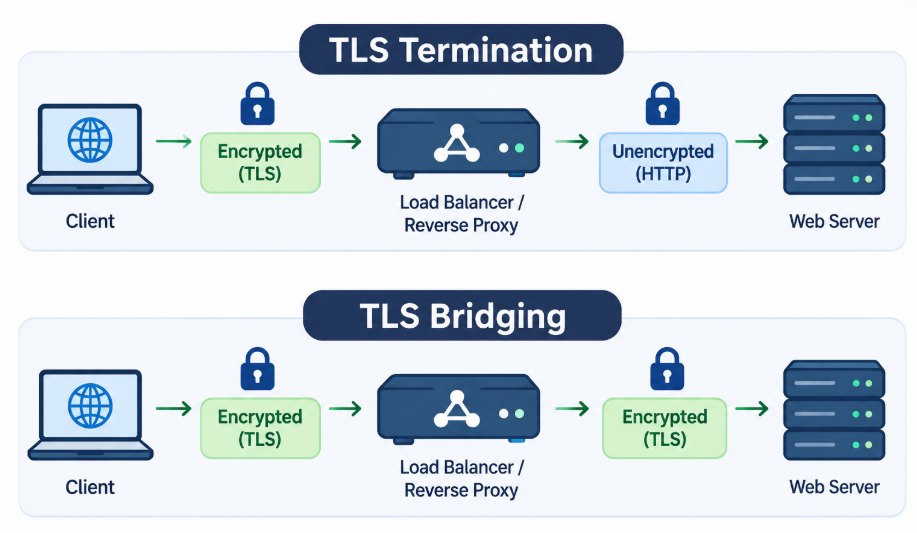
Two common TLS offloading configurations are TLS termination and TLS bridging.
1. SSL/TLS Termination
TLS termination occurs when an intermediary device handles the encrypted connection from the client and decrypts incoming traffic before forwarding it to backend servers.
In a basic termination setup:
- The visitor establishes an HTTPS connection with the load balancer.
- The load balancer uses its TLS certificate to authenticate the website and establish the secure connection.
- The load balancer decrypts incoming requests.
- Requests are forwarded to backend servers, often over an unencrypted HTTP connection.
- Responses are returned to the load balancer, encrypted, and sent to the visitor.
This configuration reduces the TLS processing workload on backend servers. However, the internal network must be adequately protected because traffic between the load balancer and backend servers may not be encrypted.
2. SSL/TLS Bridging
TLS bridging adds another encryption layer between the intermediary device and backend servers.
The intermediary terminates the client's TLS connection, decrypts incoming traffic, and then establishes a separate TLS connection to the backend server.
The process looks like this:
- The visitor connects to the load balancer over HTTPS.
- The load balancer terminates the client-facing TLS connection and decrypts the request.
- The traffic can be inspected by compatible security tools, such as a WAF.
- The load balancer establishes or uses a separate HTTPS connection to the backend server.
- The backend processes the request and returns its response over the encrypted internal connection.
TLS bridging helps protect data in transit across both network segments while allowing inspection of decrypted traffic at the intermediary.
However, re-encryption alone does not detect malware. Threat detection requires additional security tools and appropriate inspection rules.
-
*
Is SSL Offloading Secure?
SSL offloading can be secure when properly configured, but it changes where encryption begins and ends.
Website owners and network administrators should consider several factors:
- Protect the backend connection. Use HTTPS or another secure transport when sensitive data travels between the intermediary and backend servers.
- Secure private keys. The TLS private key must be stored securely on the device or service terminating the client-facing connection.
- Configure certificate validation. When the intermediary connects to backend servers over TLS, it should validate their certificates rather than blindly trusting any certificate.
- Restrict internal access. Limit access to backend servers and network components that handle decrypted traffic.
- Maintain TLS configurations. Use supported TLS versions and secure cipher suites, and keep certificates up to date.
-
*
Conclusion
SSL offloading, more accurately called TLS offloading, moves encrypted connection processing from backend web servers to a separate device or service. This can reduce server workload, simplify certificate management, and support scalable traffic distribution.
TLS termination and TLS bridging are two common approaches. Termination decrypts client traffic before forwarding it to backend servers, while bridging establishes a separate encrypted connection to protect traffic between the intermediary and backend infrastructure.
For organizations handling large volumes of HTTPS traffic, TLS offloading can be a useful part of their network architecture. The key is to balance performance improvements with proper encryption, certificate management, and protection of internal connections.
-
