


TPM vs. HSM: Key Differences, Features, and Use Cases
-
Protecting cryptographic keys is an important part of modern cybersecurity. Organizations rely on hardware-backed security technologies to prevent sensitive keys and credentials from being exposed, copied, or misused.
-
-
*
Two common technologies are:
- Trusted Platform Module (TPM)
- Hardware Security Module (HSM)
Both can protect cryptographic keys and perform security-related operations, but they are designed for different purposes.
A TPM primarily protects an individual device and supports platform integrity, while an HSM is designed for dedicated cryptographic key management and high-security operations across applications, servers, or entire organizations.
So, can a TPM be used instead of an HSM? A TPM can perform some similar functions, including secure key generation and storage, but it is generally not a replacement for an HSM in enterprise cryptographic environments.
Let's look at the main differences between TPM and HSM and where each technology fits best.
-
*
What Is TPM?
A Trusted Platform Module (TPM) is a secure cryptographic processor built into or integrated with a computer or other device.
It provides hardware-based security functions such as cryptographic key generation, protected key storage, system integrity measurements, and device authentication.
TPMs are commonly used by operating systems to protect sensitive information and verify that important parts of the system have not been unexpectedly modified.
For example, Windows uses TPM technology with services such as BitLocker and Windows Hello.
-
*
When to Use a Trusted Platform Module
A TPM is particularly useful when you need to:
- protect encryption and authentication keys on an individual device;
- verify the integrity of the boot process;
- protect credentials from software-based attacks;
- support device authentication and attestation;
- secure sensitive information on laptops, desktops, and enterprise endpoints.
TPMs are therefore primarily focused on device-level security.
-
*
Key Features of TPM Security
Secure Startup
A TPM records measurements related to the system boot process and can help verify that expected firmware and software components are being loaded.
This capability supports technologies such as secure and measured boot.
Key Generation and Storage
TPMs can generate cryptographic keys and protect them inside the device.
Keys can be bound to the TPM so that they cannot simply be copied and used on another computer.
Platform Authentication and Attestation
TPM-based attestation can provide information about the state and integrity of a device.
Organizations can use this information when deciding whether a device should be trusted to access protected resources.
Protected Cryptographic Storage
The TPM provides protected storage for cryptographic key material and other security-sensitive information.
For example, BitLocker can use TPM-protected keys as part of its disk-encryption security model.
Secure Key Management
Cryptographic operations can take place inside the TPM without exposing sensitive private key material directly to the operating system.
This creates an additional hardware-backed security boundary between protected keys and software running on the device.
-
*
What Is an HSM?
A Hardware Security Module (HSM) is a dedicated cryptographic device designed to generate, protect, manage, and use cryptographic keys.
Unlike a TPM, which is normally associated with a specific endpoint, an HSM can provide cryptographic services to multiple applications, servers, users, or systems.
HSMs are commonly used by financial institutions, enterprises, Certificate Authorities (CAs), cloud platforms, payment systems, and organizations that need strong control over high-value cryptographic keys.
They may be deployed as dedicated physical appliances, expansion cards, network-attached devices, or cloud-based HSM services.
-
*
When to Use a Hardware Security Module
An HSM is useful when you need to:
- protect high-value private and cryptographic keys;
- perform signing, encryption, or decryption operations securely;
- manage keys centrally across multiple systems;
- process large numbers of cryptographic operations;
- protect payment and transaction systems;
- support Public Key Infrastructure (PKI) or Certificate Authority operations;
- securely store keys used for Code Signing.
HSMs are particularly relevant to modern Code Signing. Publicly trusted Code Signing private keys must meet hardware-protection requirements, and GoGetSSL provides a detailed guide to Code Signing HSM and hardware requirements.
-
*
Key Features of HSM Devices
Secure Key Management
HSMs provide dedicated environments for generating, storing, using, rotating, and managing cryptographic keys.
Private keys can remain protected inside the HSM rather than being exported to ordinary servers or workstations.
Cryptographic Processing
HSMs are built specifically to perform cryptographic operations efficiently.
Depending on the device, they can handle encryption, digital signatures, key generation, certificate operations, and other cryptographic workloads at scale.
Tamper Resistance
HSMs typically include physical and logical protections designed to detect or resist attempts to access sensitive key material.
Higher-assurance devices may also provide additional protection against physical tampering.
Compliance Support
HSMs are available with certifications such as FIPS 140-2 or FIPS 140-3 and other security standards.
These certifications can be important for organizations operating in regulated industries or following specific security requirements.
-
*
TPM vs. HSM: Understanding the Differences
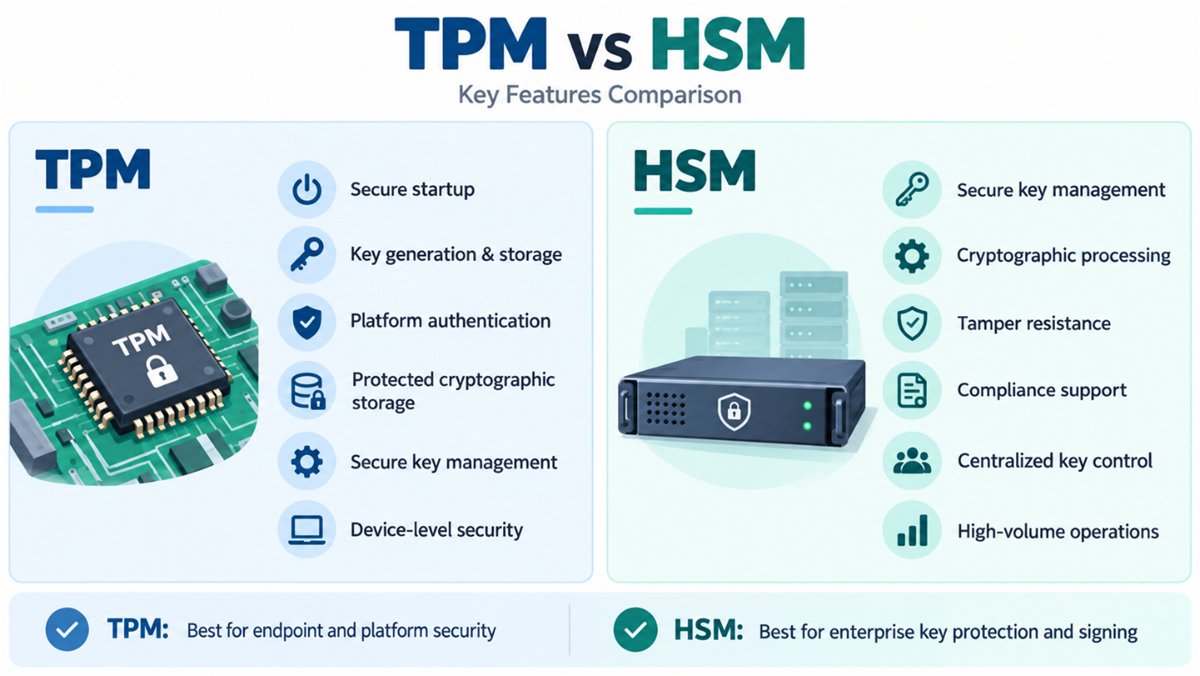
The main difference between TPM and HSM is their intended scope.
TPM is primarily designed to establish trust and protect cryptographic material on an individual device. HSM is designed to provide dedicated key management and cryptographic services for applications and organizations.
Purpose
TPM provides a hardware root of trust for a particular computer or device.
It helps protect device-specific keys, credentials, and system-integrity information.
HSM focuses on protecting valuable cryptographic keys and performing secure cryptographic operations for applications, services, and organizational infrastructure.
Scope of Use
TPMs are normally built into laptops, desktops, servers, and other computing devices.
Their security functions are closely connected to the device where the TPM is installed.
HSMs are commonly deployed as shared enterprise infrastructure and can provide cryptographic services to multiple systems or applications.
Features and Functionality
TPM capabilities are strongly associated with device security, including:
- boot integrity;
- device attestation;
- credential protection;
- disk-encryption key protection.
HSM capabilities focus more heavily on:
- key generation and storage;
- digital signing;
- encryption and decryption;
- PKI operations;
- certificate and signing infrastructure;
- centralized cryptographic services.
Key Storage and Management
Both technologies can protect cryptographic keys, but they manage them differently.
A TPM generally protects keys associated with the individual device where it resides.
An HSM is designed for broader key-management requirements and can support centralized access controls, multiple applications, key backup strategies, auditing, and enterprise key lifecycle management.
Performance and Scalability
A TPM is optimized for device-security functions rather than large volumes of cryptographic operations.
HSMs are purpose-built for cryptographic processing and can support significantly larger workloads, including environments where many applications or users need access to secure signing or encryption services.
-
*
TPM vs. HSM at a Glance
Feature TPM HSM Primary purpose Device and platform security Cryptographic key protection and processing Typical deployment Built into an individual device Dedicated, networked, or cloud infrastructure Key scope Mainly device-specific Application and enterprise-wide System integrity Strong focus Not the primary purpose Centralized key management Limited Designed for it High-volume cryptographic operations Limited Yes Common uses BitLocker, Windows Hello, attestation PKI, payments, Code Signing, enterprise encryption -
*
Conclusion
For many organizations, the choice is therefore not necessarily TPM or HSM. The two technologies can complement each other: TPM can protect individual endpoints while HSM infrastructure protects critical organizational keys and signing operations.
A TPM can securely generate and protect device-specific cryptographic keys, however, it should not be treated as a replacement for an HSM in modern publicly trusted Code Signing workflows. Certificate Authorities such as Sectigo and DigiCert require Code Signing private keys to be protected by approved hardware tokens, HSMs, or compliant cloud-based signing environments.
Organizations that use HSM-backed keys for software distribution can also explore Code Signing Certificates available through GoGetSSL.
-
